
Gold plating on contacts and connector pins
We gold plate connector pins, sockets and electrical contacts in soft gold or hard gold over a nickel underlayer. Small parts run loose in barrel or vibratory lines; larger parts go on racks.
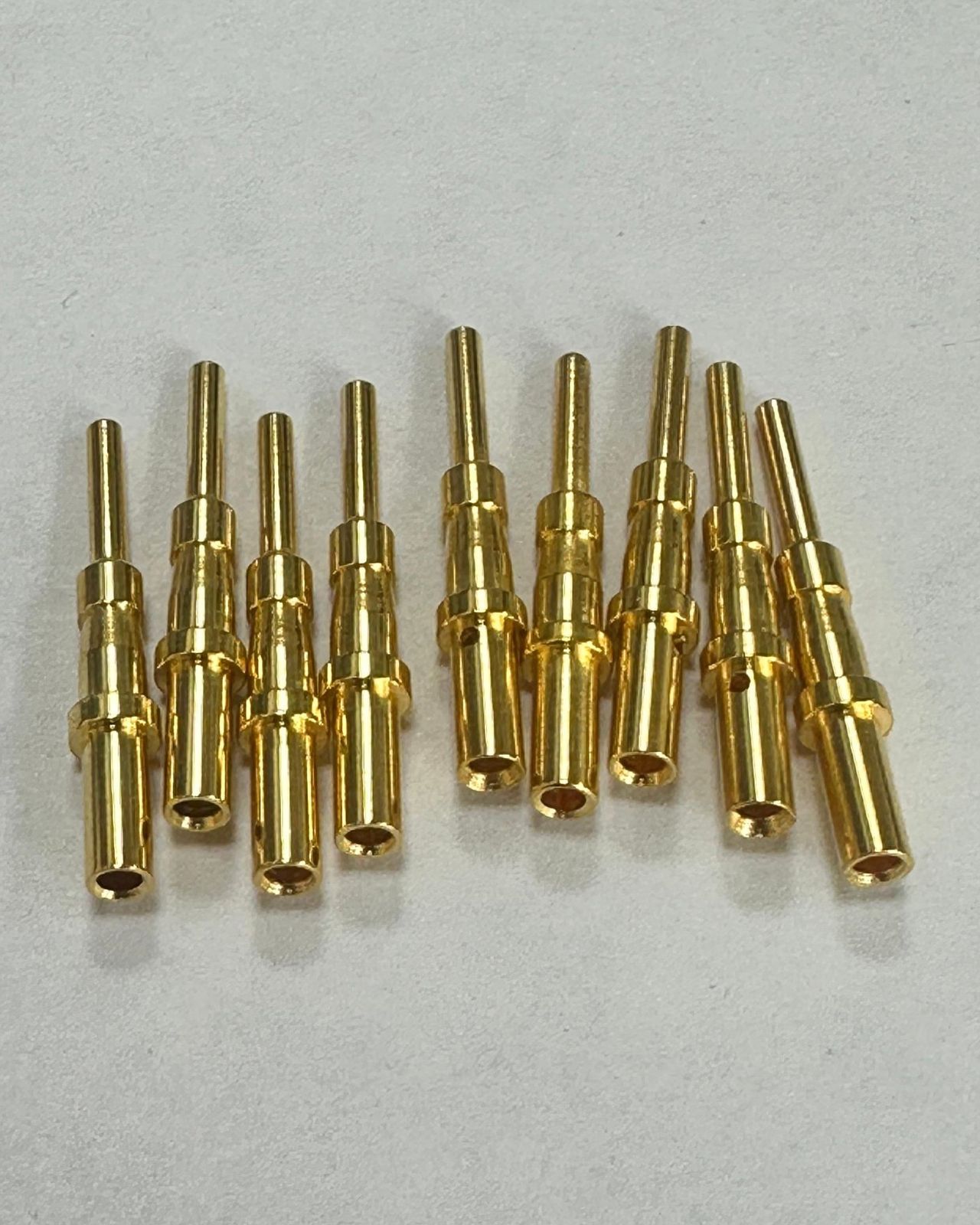
- Part
- Connector pins
- Finish
- Gold
Why contacts are gold plated
Gold does not oxidise or tarnish, so a gold contact keeps a low, stable contact resistance for years, even at the low forces and currents of signal contacts. That is why connector pins and sockets, and contacts in rail, RF and electronic equipment, are usually gold over nickel.
Soft or hard gold
The choice depends mostly on how often the contact is mated.
| Soft (pure) gold | Hard gold | |
|---|---|---|
| What it is | 99.9% gold or better | Gold-cobalt, about 99% gold and 1% cobalt |
| Wear resistance | Lower | Higher |
| Typical use | Contacts mated rarely, soldered or wire-bonded parts, RF surfaces | Pins and sockets mated many times |
If your drawing only says "gold plate", tell us how often the part is mated and we will suggest which to use.
Barrel, vibratory or rack
| Line | How parts are plated | Suits |
|---|---|---|
| Barrel | Loose parts tumble in a rotating barrel in the plating solution | Large quantities of small pins, sockets and contacts. Every surface is plated. |
| Vibratory | Loose parts move through the solution in a vibrating bowl instead of tumbling | Large quantities of small parts that should not tumble. Every surface is plated. |
| Rack | Each part is fixed to a rack | Larger or delicate parts, and selective plating of the contact area |
In barrel and vibratory lines, every surface of the part is plated. If only the contact end of a part needs gold, tell us in your enquiry. Selective plating is done on racks, with the other areas masked, which keeps the cost of gold down on larger parts.
Nickel underlayer
On copper-alloy pins and contacts, gold is plated over nickel. The nickel stops copper from diffusing up into the gold, which would discolour it and raise contact resistance over time, and it seals the base metal under any pores in a thin gold layer.
Under gold we usually plate German nickel, a low-stress, ductile nickel. It does not crack when pins are crimped or press-fitted. See nickel plating.
Thickness
Very thin gold, often called flash gold, is porous and suits contacts that are mated a few times in clean conditions. Contacts that are mated often, or that work in humid or polluted air, need thicker gold. Give the minimum thickness on the drawing and where it is measured, usually the contact area.
If part of the pin is soldered, such as a solder cup, mark it on the drawing. Gold dissolves into solder, and too much of it makes a solder joint brittle, so solder areas often need thinner gold than the contact end.
Inspection
Gold and the nickel under it are measured from the same spot in one reading on our Fischerscope XRF instrument, which reads up to three coating layers. Parts are not damaged. We supply an XRF thickness report with each batch. Adhesion tests are run as your drawing or specification requires; see quality and testing.
Drawings may cite ASTM B488, MIL-DTL-45204, ISO 27874 or IS 3266; the gold plating page explains what each covers. Send the specification and revision with your drawing and we will confirm whether we can meet it.
What to send with your enquiry
- Drawing, with the base material: brass, phosphor bronze, beryllium copper or other
- Soft or hard gold, or the specification type and grade
- Minimum gold thickness in µm, and where it is measured
- Nickel underlayer thickness
- Areas to plate, if not the whole part, and any solder or crimp areas
- How often the part is mated
- Quantity per lot and expected yearly volume
Email your drawing for a quote
Attach the drawing and include as much of this list as you can. The more you send, the fewer questions we need to ask before quoting.
- Drawing: PDF, DWG, DXF or STEP
- Base material and grade
- Finish, and thickness in µm
- Quantity per lot and yearly volume
- Areas to mask, if any
- Standard or customer specification